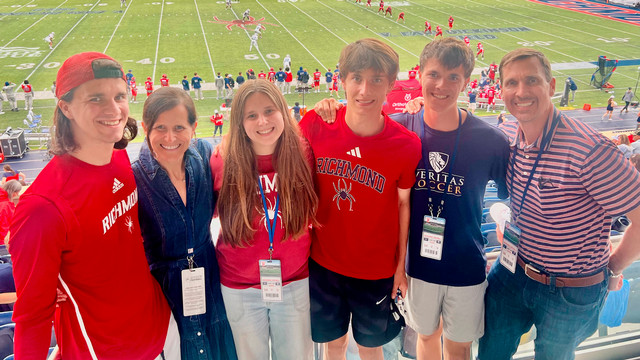
Richmond parents reflect on connection and care
Family Profile
Jacquelin and Scott Aronson discuss watching their children grow, building relationships within the Spider community, and caring for their neighbors throughout the city they call home.
Parents and families are an essential part of the University of Richmond community and play an important role in enriching the student experience. Through this new series of parent and family profiles, we’ll introduce some of the people behind our students — sharing their perspectives, interests, and the many ways they engage with and contribute to the University.
Q&A with Jacquelin and Scott Aronson, P’27 and P’28
Jacquelin and Scott Aronson are the parents of Jack, a Richmond senior, and Jayne, a junior. They have found many ways to connect with the University and other Spider families while watching their children establish communities of their own.
To start us off, please tell us about your family.
Jacquelin: Scott and I have been married 24 years and have five children. Jack and Jayne are a senior and junior, respectively, at the University of Richmond. Their younger brothers, Joseph and Howe, are a senior and junior at Veritas School in Richmond.
We sadly lost our first son, Robert Scott, in infancy. Everything we share about our family is informed by our loss and by what we have learned about the fragility and blessing of life. It has shaped our desire to appreciate the lives we have been given and to return that gift by caring for others.
Scott: Jack and Jayne are both in the Robins School of Business. Jack is studying business administration with concentrations in data analytics and marketing, along with a minor in history. Jayne is studying business administration with concentrations in entrepreneurship and marketing and has developed her own photography business.
They were both three-sport athletes in high school and have found a sense of belonging within Richmond’s basketball programs. Jack is a student manager for the men’s basketball team and a practice player for the women’s team, while Jayne is a student manager for the women’s team. They take those responsibilities very seriously.
What first stood out to your family about Richmond, and what made it feel like the right place for Jack and Jayne?
Jacquelin: Richmond was their choice. We did our part to support them as they considered their next steps, but ultimately, they each decided that Richmond was the place where they felt most comfortable.
We happen to live nearby, but we wanted them to fully embrace the University community. We wanted them to learn that they were prepared to live independently before returning to the places and routines that were already familiar to them.
Sending your children to college is a significant transition, even when they are only a few miles from home. What reassured us was discovering how many genuine, down-to-earth people are here. In our interactions with faculty, staff, University leaders, other students, and their families, we have seen there is a great deal of care on this campus, and that has helped us trust that our children are in a place where people are invested in their well-being.
How have you seen your children grow during their time at Richmond?
Jacquelin: Now that they are here, I have been able to see more clearly who our children are. When children are living at home, and you are immersed in the day-to-day, it can be easy to lose sight of what makes each one unique.
Scott: We encourage them to stretch beyond what is required and take advantage of the range of opportunities available here. Jack, for example, has paired his business studies with his interest in history. College should be a time to take a different kind of class, try something new, and discover interests you may not have anticipated.
We also appreciated hearing during orientation that Richmond is a safe place to try something and sometimes fail. That was reassuring to us as parents because growth comes especially in and through hard times.
What experiences have been especially meaningful to them?
Scott: The basketball programs and their involvement in a Christian faith-based student organization have been particularly meaningful. Both have given them smaller communities within the University and opportunities to form relationships with students from different majors, backgrounds, and interests, and to help the programs grow.
Their work with the basketball teams has also allowed them to represent something larger than themselves. Both traveled with the women’s basketball program during its NCAA tournament runs, including the trip to Los Angeles. They were not simply traveling; they were there in a role, representing their team and the University. That was very meaningful to them.
Jacquelin: It has also been rewarding to see them extend to others the welcome they received. Jack helped Jayne connect with a community when she arrived, and now Jayne is reaching out to first-year students and helping them find their place. There is a wonderful cycle at a university: As students become upperclassmen, they can offer others the support and welcome someone once offered them.
What have you come to appreciate most about the Richmond community?
Jacquelin: The people. We encourage parents to meet the administrators, professors, students, other families, librarians, dining staff, people taking tickets at a game, and I could go on. Look people in the eye, extend your hand, and get to know them. Otherwise, your child could be here for four years and you could miss much of what makes this community special.
Scott: Our children have close friends from across the country, and we have enjoyed getting to know their families. During Family Weekends, we have invited their friends and parents to our home.
Jacquelin: The first time was very last-minute, and we had not met many of them before. Everyone helped pull the meal together, and it was wonderful. It may seem harder to connect with other families once your children are in college, but there are still many opportunities. Get to know the families of the people who are becoming important in your child’s life.
Your family has also traveled together extensively. How has that shaped you?
Scott: When our children were young, we decided we wanted them to know our country. Our goal was to visit all 50 states over 10 years. For a state to count, we had to spend at least one night and do something distinctive to that place. We took most of the trips in our minivan — the same one Jack now drives on campus.
Jacquelin: We visited national parks and state capitals, picked blueberries in Michigan, surfed in California, went to a rodeo in Texas, and ice climbed in Alaska. Hawaii was our final state. We recognize that not every family has the opportunity to do something like that, and we do not take those experiences for granted. We hope the trips helped shape our children’s perspectives and gave them something valuable to contribute in the classroom and in their relationships with people from different places.
Outside of your connection to the University, what work is especially important to your family?
Scott: One of the first things I did after moving to Richmond more than 20 years ago was volunteer with The Salvation Army. That eventually led to serving on the organization’s board.
The Salvation Army is now working with the City of Richmond to create a Center of Hope that will provide shelter and on-site services for people experiencing homelessness. It will be designed to support men, women, and families step onto a path that will help them transform their lives. Because the current shelter is only about a mile from our home, we are reminded daily of the hundreds of neighbors who are suffering throughout Greater Richmond.
Jacquelin: After Scott and I hosted a gathering at our home in November 2025 to help people learn about the future Center of Hope, I felt called to bring more women into the conversation. That eventually, and unexpectedly, led to launching RVA Women Lifting Up Hope, a faith-based, grassroots movement that invites women across the Richmond region to support their neighbors in whatever way is right for them — whether that means learning more, sharing information, touring the current shelter, or contributing financially.
For me, the work to help make the Center of Hope a reality is ultimately about changing how we see one another. A person experiencing homelessness has a name, a story, and a family. Homelessness is a season in someone’s life; it does not define who that person is.
Editor’s Note: To learn more about the Center of Hope, you may email Jacquelin and Scott directly at RVAWomenLiftingUpHope@gmail.com.
How does that commitment connect with your experience as Richmond parents?
Scott: It can be easy for any of us to become absorbed in our own lives, but we also have neighbors nearby who, due to life circumstances, are worried about where they will sleep or where their next meal will come from. For Jacquelin and me, it is unacceptable in Richmond to have neighbors in desperate need of this basic support. We also grieve for the people who are in need in places beyond Richmond.
Jacquelin: The truth is that parents are not simply sending their children to the University of Richmond; they are sending them to the Richmond region, which becomes their home during their college years. Whether students remain here or move elsewhere after graduation, they will always have a connection to this university and city. We hope Spider families will think about how they can care for their neighbors here — and how they might carry the same heart to help hurting neighbors in their own communities.
When you think about Richmond’s future, what excites you most?
Jacquelin: I am most excited to ponder how the blessings across the University of Richmond can also become blessings across the larger Richmond community, especially for our neighbors who are too often overlooked and misunderstood. We are truly grateful that the University is committed to the well-being of each student.
Scott: With Richmond supporting students in discovering their gifts, building meaningful relationships, and learning how they can contribute to something larger than themselves, we are excited to see our children and their classmates take what they are learning and experiencing as students here at the university, and as neighbors in Richmond, Virginia, and choose to live full lives that include seeing and caring for all neighbors in the communities where they live.